
Research
For my publications, please see my Google Scholar profile. Feel free to contact me in case you do not have access to (some of) my articles. Here, I describe some of my research with a bit of narrative and context.
Synthetic light-harvesting complexes
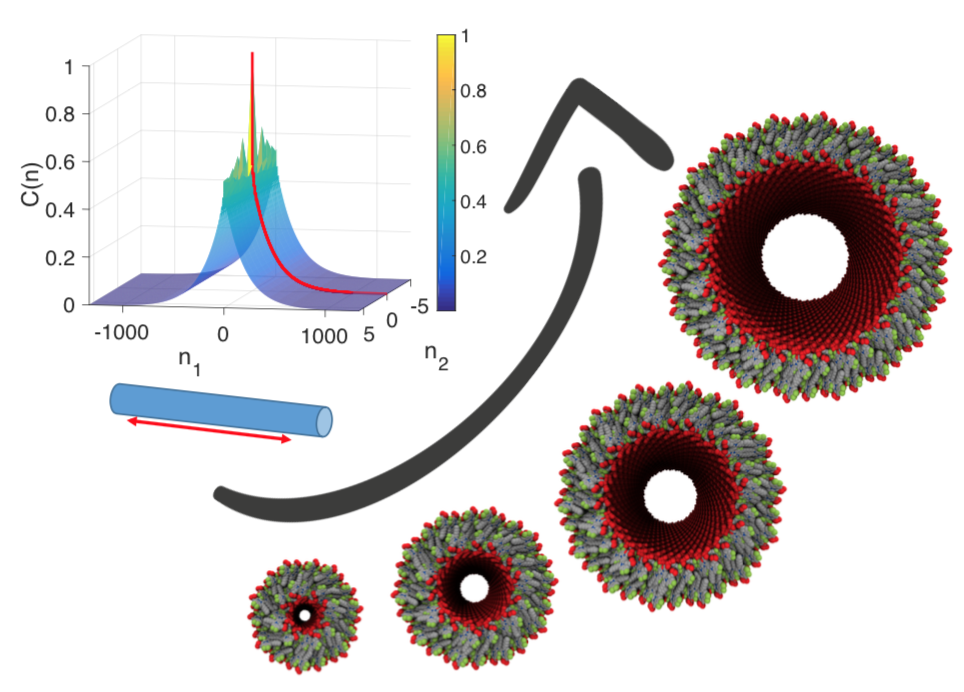
We modeled large tubular aggregates of cyanine dyes, which are synthetic analogues of chlorosomes, and explained optical changes observed in their absorption spectra [J. Phys. Chem. Lett. 2017]. We expanded these findings into a systematic study of aggregate size effects on optical and electronic properties to get insights into design rules for molecular electronics [J. Chem. Phys. 2020]. In parallel, we went beyond phenomenological modeling by including atomistic information into the model: besides reproducing optical properties, the model allows us to unravel the microscopic origin of the photophysical properties of such aggregates [Chem. Sci. 2020]. The detailed picture provided by this model is able to resolve the origin of molecular and excitonic disorder in C8S3 nanotubes [JACS 2020].
Intermolecular energy transfer

Recently, we have comprehensively compared three computational models for energy transfer in multichromophoric complexes [Chem. Phys. 2020]. We compared the multichromophoric Forster resonance energy transfer (MC-FRET), the numerical integration of the Schrodinger equation (NISE), and the Haken-Strobl-Reineker (HSR) model, using as a reference the numerically exact Hierarchy of Equations of Motion (HEOM). We investigate their behavior in various system and parameter regimes, including the regime relevant to natural light-harvesting systems. Check out [Chem. Phys. 2020] to find out which method did the best.
Modeling of nonlinear spectroscopy
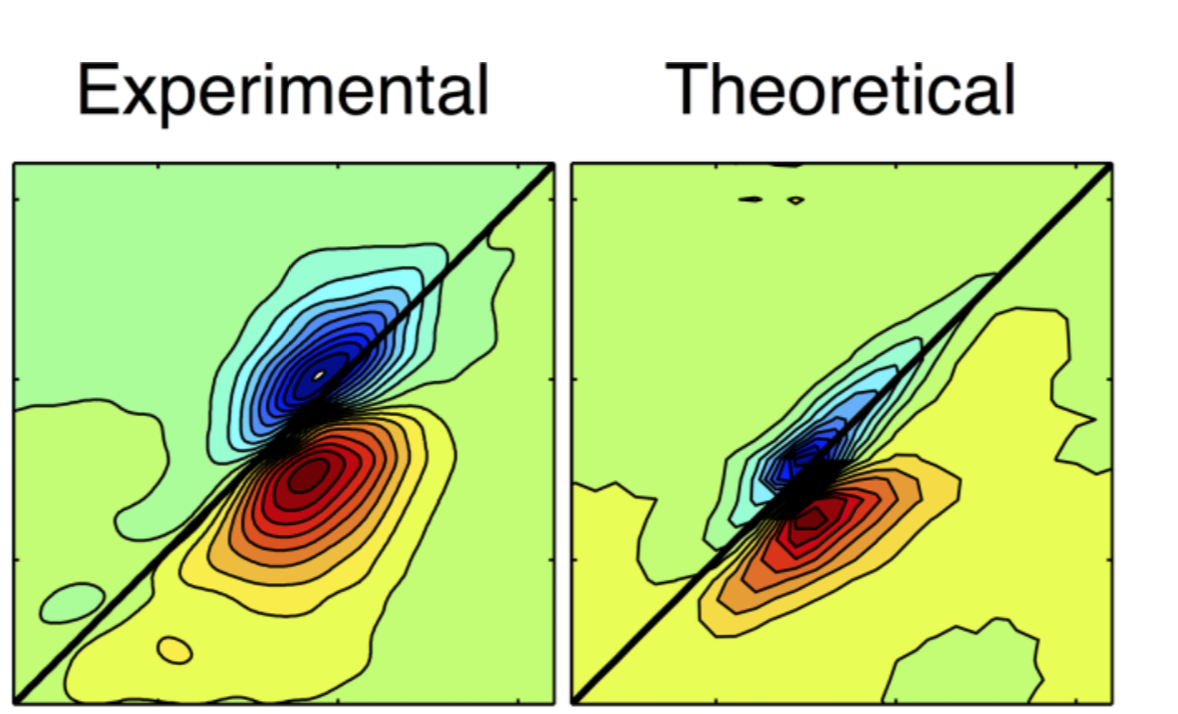
We developed a benchmark method to probe protein conformational changes based on two-dimensional infrared spectra [J. Chem. Phys. 2015, J. Chem. Theory Comput. 2016]. Two-dimensional modeling of infrared spectra also helped Wojciech unravel the microscopic mechanism behind the strict ion selectivity of potassium channels [Nat. Chem. 2018].